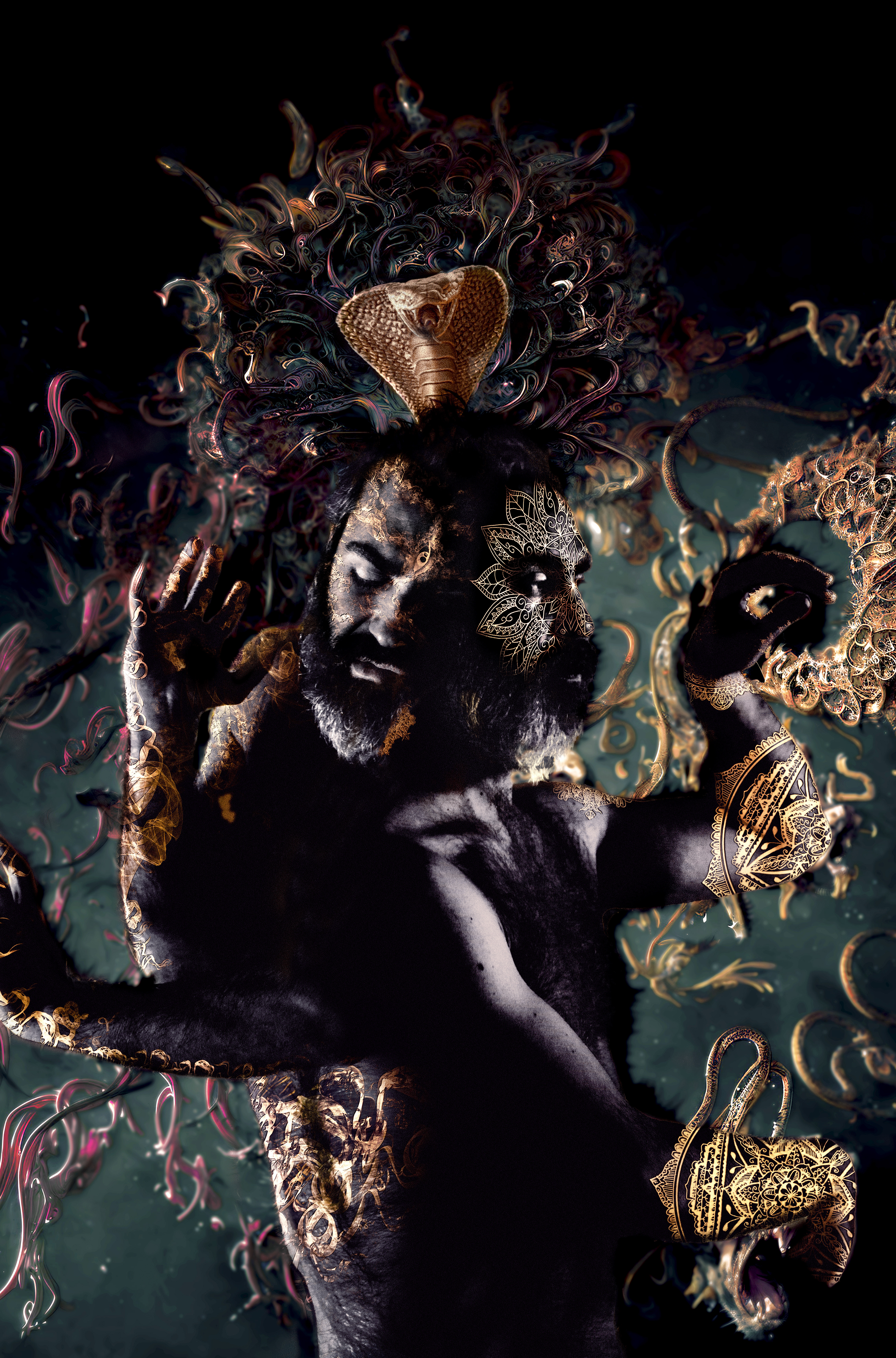
Where do the boundaries of the body start and the spirit begin? Are these two vital elements that make up human existence even separate? Does one cease to exist when the other is not aware of the existence of the other? What are the spiritual ties that link them? One being formless and eternal in nature, and the other bound by the rules of decay and naturely bias. Just because one is acting as the exact opposite of the properties that the other represents, it does not replace or cease to exist in any way, shape or form.

What are Chakras?
The Energy Architecture of Consciousness, chakras are Inner Doors through which consciousness descended into the body and must eventually ascend to reunite with Spirit ( Cosmic Consciousness).
They are subtle nerve plexuses where consciousness expresses itself at different vibratory levels. Think of them as stations on the soul’s elevator, running from dense matter to pure Spirit. The Chakras are the pathway through which life energy (prana) and awareness must ascend so the individual soul can reunite with the infinite (cosmic Consciousness)
The purpose of the chakras is two-fold:
1. Life Maintenance: They function as specialised "transformers" that take the infinite cosmic energy and step it down to manage the body’s physical functions (organs, nerves, and senses).
1. Life Maintenance: They function as specialised "transformers" that take the infinite cosmic energy and step it down to manage the body’s physical functions (organs, nerves, and senses).
2. Spiritual Evolution: They serve as the pathway for the devotee. By practising Kriya Yoga, I work to withdraw energy from the senses and direct it back up these centres to achieve Samadhi (oneness with God).
THE SPINE AS THE ALTAR OF GOD
Before examining each chakra, it is essential to understand Yogananda's foundational teaching: the spine is the altar of God in the human body. The entire cerebrospinal system is an inverted tree of life — the very Ashvattha tree described in Chapter 15 of the Bhagavad Gita:
"He (the yogi) who knows the Ashvattha tree — with its roots above and branches below, and whose leaves are the Vedic hymns — is a knower of the Vedas."
— Gita 15:1 (Yogananda's translation)
— Gita 15:1 (Yogananda's translation)
Yogananda interprets this verse as a precise description of the human nervous system. The "roots above" are in the brain — the Sahasrara — the thousand-petaled lotus that draws sustenance from Spirit. The "trunk" is the spinal cord (the Sushumna channel). The "branches" spreading downward are the sensory and motor nerves emanating from the chakras, and the "leaves" are the countless sensory experiences that create the rustling distraction of worldly life. The devotee's task, as Krishna instructs Arjuna, is to "cut down this firmly rooted tree with the strong axe of non-attachment" (Gita 15:3) — that is, to withdraw the life force from the outward-flowing branches of sensation and reverse its current upward through the spine, through each chakra, until it merges in its divine source.
This reversal of energy flow is the essence of Kriya Yoga. And the Bhagavad Gita, in Yogananda's reading, is essentially the scripture of this inner science.
Three great subtle channels (nadis) run through the spine:
Sushumna (the central, deepest channel) — corresponds metaphorically to the hidden river Saraswati
Ida (the left channel, lunar, cooling) — corresponds to the Ganga
Pingala (the right channel, solar, heating) — corresponds to the Yamuna
These three converge at the Ajna chakra (the point between the eyebrows), forming the sacred Triveni — the inner confluence of holy rivers. It is here, at the "spiritual eye," that the devotee's concentration must ultimately rest.
Yogananda connects this triune structure to the Gita verse:
"Shutting out all external sense contacts, fixing the gaze between the eyebrows, equalising the ingoing (prana) and outgoing (apana) breaths flowing through the nostrils..."
— Gita 5:27
— Gita 5:27
This verse is a direct instruction in the yogic technique of withdrawing consciousness from the outer senses, balancing the dual currents of Ida and Pingala, and entering the Sushumna to ascend through the chakras.
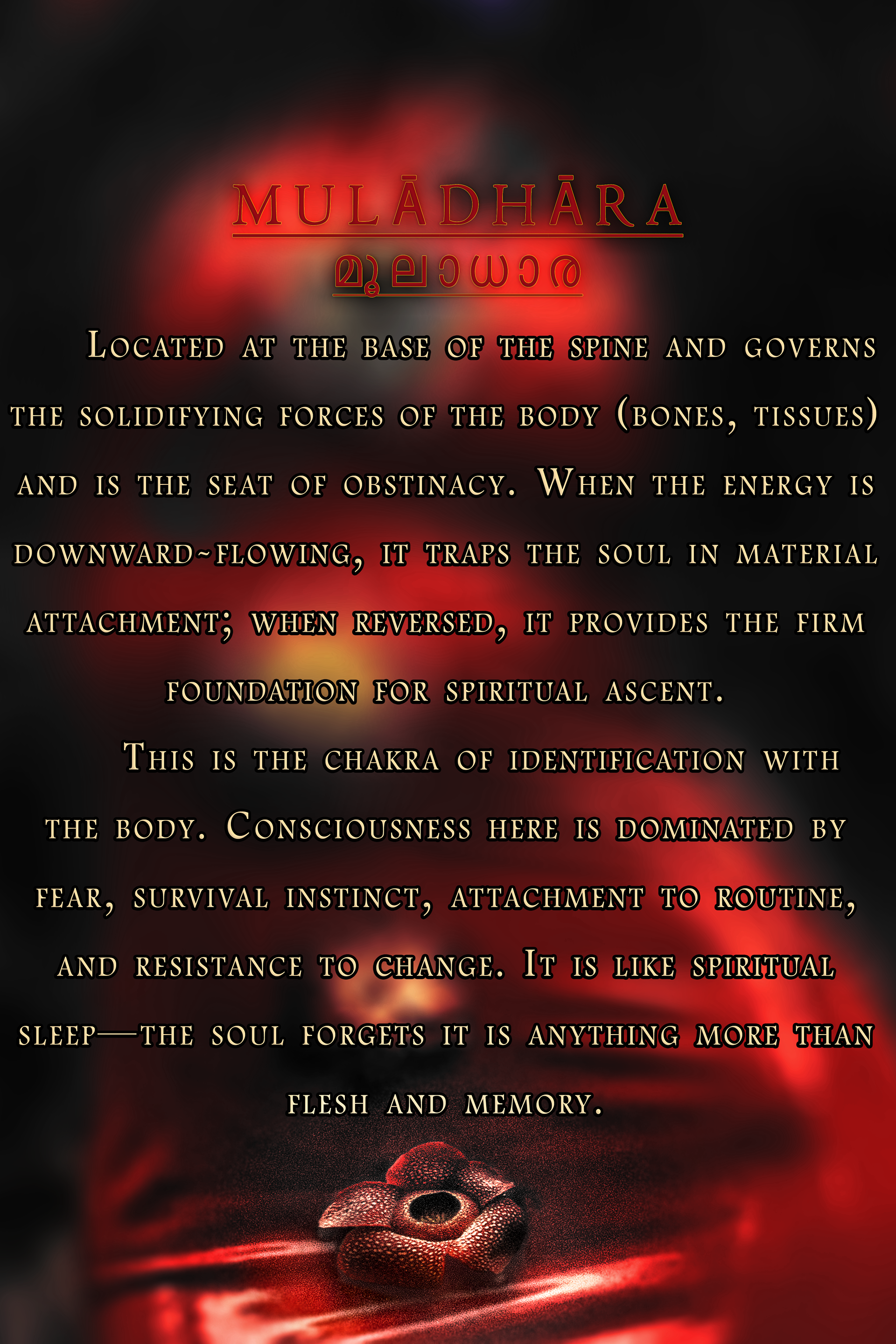
Mūlādhāra
Properties and Significance
The Muladhara chakra is the foundation of the bodily temple. It governs the earth element in the body — everything that is solid, dense, and structured: bones, muscles, teeth, nails, and the physical frame itself. Yogananda teaches that when consciousness is predominantly centred at this chakra, a person is primarily concerned with physical survival, bodily security, and material grounding. The mind here is most identified with the body as the self.
This is the seat of the dormant Kundalini Shakti — the coiled serpent power — which Yogananda identifies as the concentrated cosmic energy that originally descended from Spirit through the chakras to create the bodily form. In its dormant state, it keeps consciousness anchored to the physical plane. When awakened through proper yogic practice (especially Kriya Yoga), it begins its ascent through the Sushumna, activating each chakra in turn.
State of Consciousness
At this level, awareness is dominated by tamas (inertia, darkness). The person is preoccupied with eating, sleeping, self-preservation, and fear. Spiritual aspiration is at its lowest. The ego identifies completely with the physical body and its needs. Yogananda relates this to the Gita's description of tamasic nature: "O Partha (Arjuna), when darkness (tamas) prevails, these arise: absence of illumination, inactivity, negligence, and delusion." — Gita 14:13
The person trapped at the Muladhara level lives, in effect, in a state of spiritual sleep — the very condition from which Krishna exhorts Arjuna to awaken.
Connection to the Gita
The Muladhara's earth element corresponds to the most material level of Prakriti (Nature). In Chapter 7, Krishna describes his eightfold Nature: "Earth, water, fire, air, ether, mind (manas), intellect (buddhi), and ego (ahamkara) — these constitute My eightfold divided Prakriti." — Gita 7:4
Earth, the densest element, corresponds to the lowest centre. The devotee at this stage is identified with the gross body — the annamaya kosha (food sheath). The journey of the Gita begins, in a sense, from here — from Arjuna's despair and bodily attachment on the battlefield, his trembling limbs and faltering resolve (Gita 1:28-30), to his ultimate liberation. The conch Manipushpaka, blown by Sahadeva (the youngest Pandava, representing the quality of adherence to righteousness at the most basic level), is associated with this centre. Its sound indicates that even at the foundational level, the divine call can be heard if one listens.
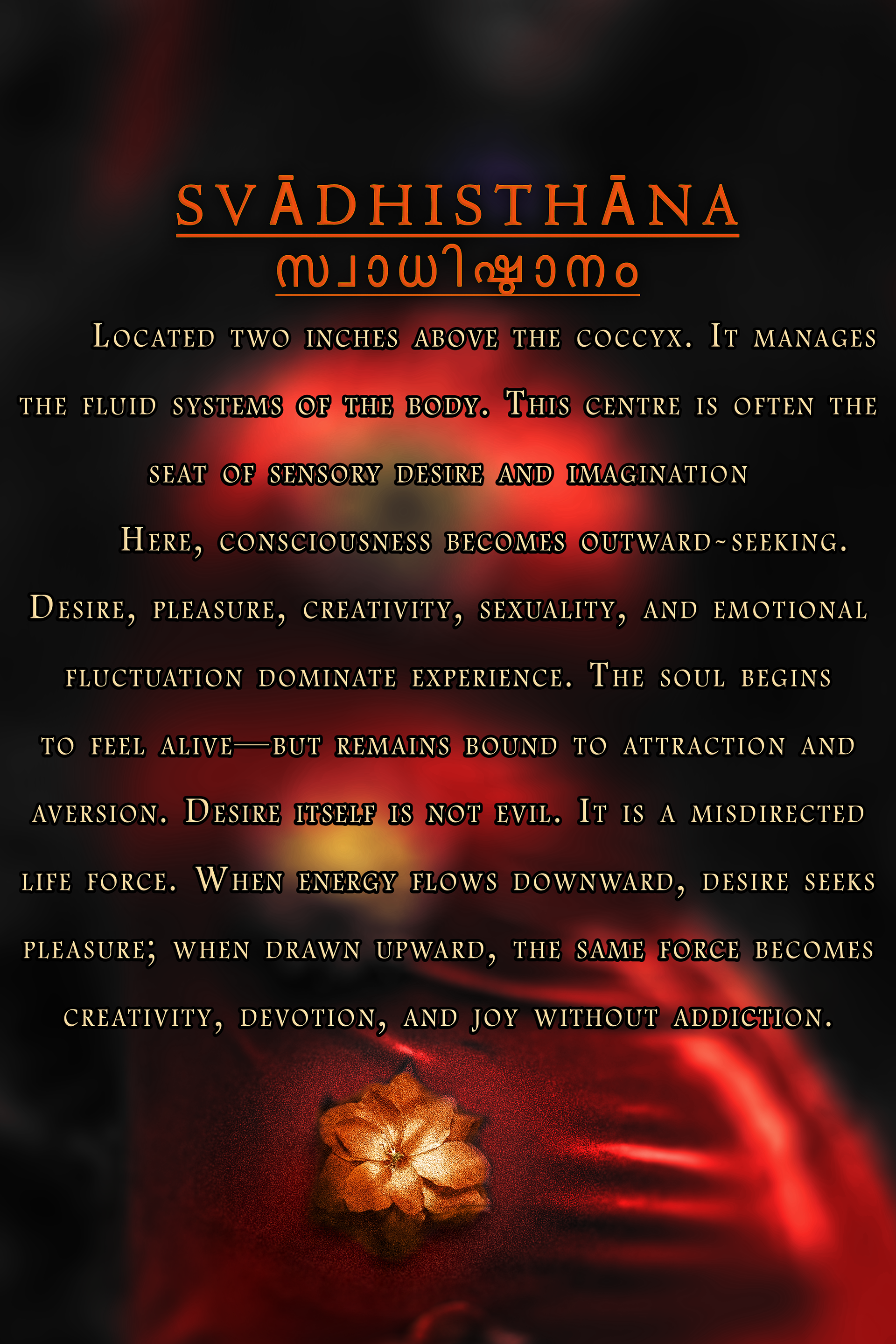
Svadhisthana
Properties and Significance:
The Svadhisthana chakra governs the water element — all that is fluid in the body: blood, lymph, saliva, sexual fluids, and other liquid substances. When consciousness dwells primarily at this centre, a person is governed by sensual desire, emotional reactivity, pleasure-seeking, and procreative urges. The world is experienced primarily through the lens of attraction and repulsion, likes and dislikes, craving and satiation.
Yogananda teaches that this centre, when misdirected, enslaves the life force in the pursuit of sensory pleasures — particularly sexual indulgence. However, when the energy of this chakra is sublimated and redirected upward, its tremendous creative power is transmuted into spiritual vitality — ojas — which fuels higher meditation. The name "Svadhisthana" itself is revealing: sva means "self" and adhisthana means "dwelling place." Yogananda notes that when the soul's energy descends to this level, it "dwells" in the realm of sensory self-indulgence rather than in its true home of Spirit.
State of Consciousness.
At this level, rajas mixed with tamas predominates. The person is restless with desires, emotionally volatile, and driven by pleasure and pain. There is more animation than at the Muladhara level, but it is directed outward toward sense objects rather than inward toward the Self. This is precisely the condition Krishna addresses when he warns: "From brooding on sense objects, attachment to them arises. From attachment springs desire; from (unfulfilled) desire, anger appears." — Gita 2:62
And: "From anger comes delusion; from delusion, loss of memory (of one's true Self); from loss of memory, the destruction of discrimination; from the destruction of discrimination, one perishes." — Gita 2:63
This is the descending cascade of consciousness that occurs when energy remains pooled in the lower chakras. Yogananda calls this the "downward pull" of Maya — the cosmic delusive force that keeps the soul imprisoned in the cycle of desire and gratification. Connection to the Gita The water element of Svadhisthana finds its Gita reference when Krishna declares: "I am the fluidity in water." — Gita 7:8.
Even in this element of desire and fluidity, the Divine is present — but it is hidden, masked by the outward flow of attraction. The devotee's task is to perceive the divine essence behind the element, not to be swept away by its current. The conch Sughosha ("sweet-sounding"), blown by Nakula (representing the quality of adherence to divine law), sounds from this centre during deep meditation — the sweet flute-like call of Spirit beckoning the soul away from sensory indulgence toward inner joy. Yogananda also connects the mastery of this chakra to the Gita verse: "Objects of sense turn away from the abstinent man, leaving the longing (rasa, taste) behind; but this longing also turns away after he beholds the Supreme." — Gita 2:59
Note the word rasa — "taste" — the very sense governed by Svadhisthana. Only by tasting the supreme bliss of higher consciousness does the lingering craving for sensory pleasure finally dissolve.
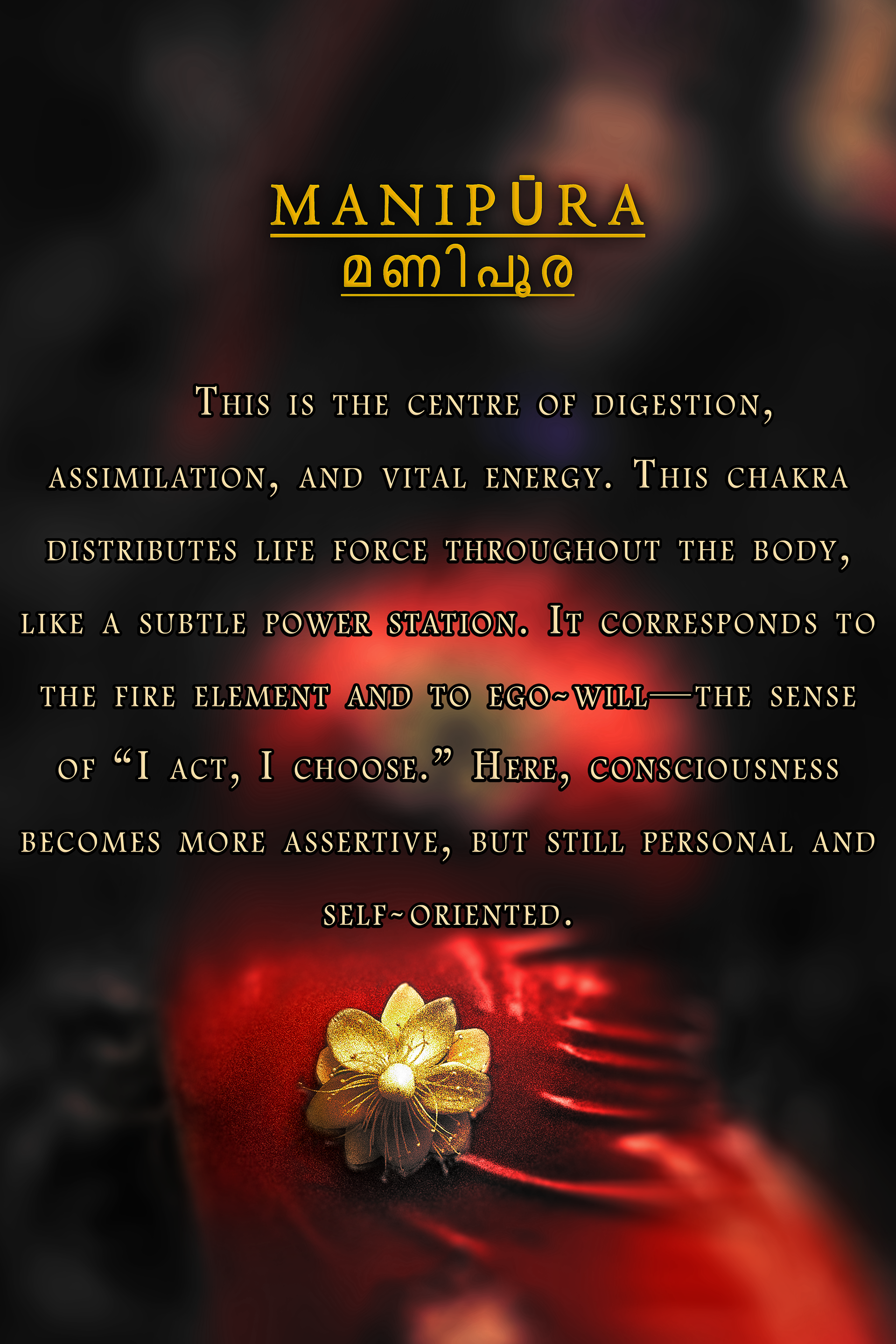
Manipura
Properties and Significance:
The Manipura chakra governs the fire element — the transformative power of digestion (both physical and psychological), metabolism, and dynamic will. It is the centre of personal power, ambition, self-assertion, and fiery determination. When functioning in its lower aspect, it manifests as anger, domination, aggressive pride, and the burning restlessness of unfulfilled ambition. When purified and directed upward, its fire becomes the blazing aspiration for truth — mumukshutva — the burning desire for liberation.
Yogananda describes this centre as the seat of fiery rajas — the quality of dynamic action, often entangled with ego. The warrior nature — both its nobility and its destructiveness — resides here. It is no coincidence that Arjuna, the warrior, must confront and transcend these very qualities.
State of Consciousness:
Rajas (passionate activity) dominates. The person has considerable energy and drive but is often enslaved by ego, competitiveness, and the desire for recognition and control. There is a quality of "fire" in the personality — inspiring when directed toward higher goals, consuming when misdirected. Yogananda connects this to Krishna's teaching: "O Arjuna, when rajas prevails, these arise: greed, outgoing activity, undertaking of selfish actions, restlessness, and craving." — Gita 14:12
Rajas (passionate activity) dominates. The person has considerable energy and drive but is often enslaved by ego, competitiveness, and the desire for recognition and control. There is a quality of "fire" in the personality — inspiring when directed toward higher goals, consuming when misdirected. Yogananda connects this to Krishna's teaching: "O Arjuna, when rajas prevails, these arise: greed, outgoing activity, undertaking of selfish actions, restlessness, and craving." — Gita 14:12
Yogananda explains this as a direct reference to the Manipura's digestive fire, but also as a deeper teaching: the cosmic fire of consciousness that "digests" — assimilates and transforms — all experience. The yogi who masters this centre learns to transform the raw material of worldly experience into spiritual wisdom. The conch Paundra, blown by Bhima (representing the immense life force — prana — of the body), is associated with this centre. Bhima's colossal strength represents the tremendous energy available at the Manipura level. When this energy is harnessed for the spiritual battle, it becomes an unstoppable force for Self-realisation. The name "Manipura" itself — "city of lustrous jewels" — indicates that hidden within this fiery centre is a radiant treasure: the jewel of will transformed into divine aspiration.
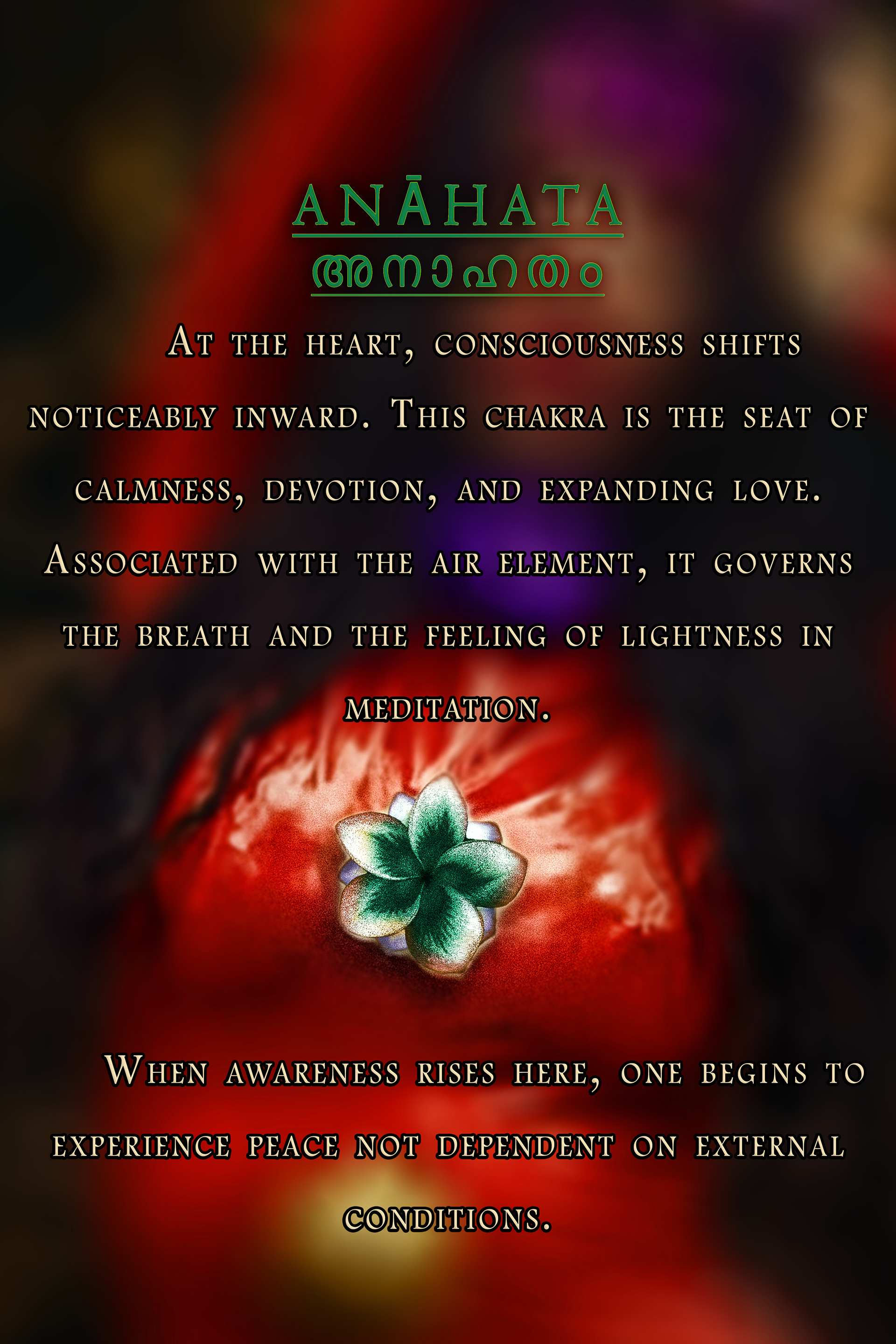
ANAHATA CHAKRA — The Dorsal Centre (Heart Centre)
Properties and Significance
The Anahata chakra marks a pivotal transition in the spiritual journey. It is the centre of divine love, devotion (bhakti), compassion, and the feeling faculty of the heart. Yogananda teaches that when consciousness ascends to this level, a fundamental shift occurs: the devotee begins to move from ego-centred existence to soul-centred awareness. The overwhelming experience at this centre is one of love — not the possessive, conditional love of the lower nature, but the beginning of selfless, expansive divine love.
The name "Anahata" means "unstruck" — referring to the cosmic sound that arises without any physical striking or contact. This is the primordial vibration of AUM that sustains all creation. Yogananda relates this to the deep bell-like sound heard in meditation when consciousness reaches this centre — a sound that reverberates with the very heartbeat of the cosmos. The air element governed by this chakra represents expansion, freedom, and all-pervasiveness. Just as air fills all available space, the consciousness at Anahata begins to expand beyond the confines of personal ego into a wider field of awareness and sympathy with all life.
This is the seat of feeling — the capacity to "touch" and be "touched" by reality at a deeper level. Yogananda emphasises that feeling is the most important faculty for the devotee. Intellectual understanding alone cannot lead to God; it is the feeling of the heart — devotion, longing, love — that draws the soul irresistibly toward the Divine.
State of Consciousness:
Sattva mixed with rajas begins to dominate. The person becomes naturally inclined toward devotion, service, compassion, and the desire to know the deeper meaning of life. Spiritual aspiration begins to outweigh material ambition. The quality of life shifts from acquisition to offering.
This is where the Gita's teaching on Bhakti Yoga finds its physiological seat. Krishna's most intimate and personal declarations of love — the verses that have melted the hearts of devotees for millennia — resonate from this center: "Those who, renouncing all actions in Me, and regarding Me as the Supreme, worship Me, meditating on Me with single-minded yoga — for them, whose minds are fixed on Me, O Partha, I become ere long the deliverer from the ocean of mortal samsara (the rounds of birth and death)." — Gita 12:6-7
"Touch" (sparsha) — the sense of the air element — here refers to all contact between consciousness and the world. At the heart level, the devotee learns to feel all experiences without being enslaved by them, maintaining equanimity in both pleasure and pain.
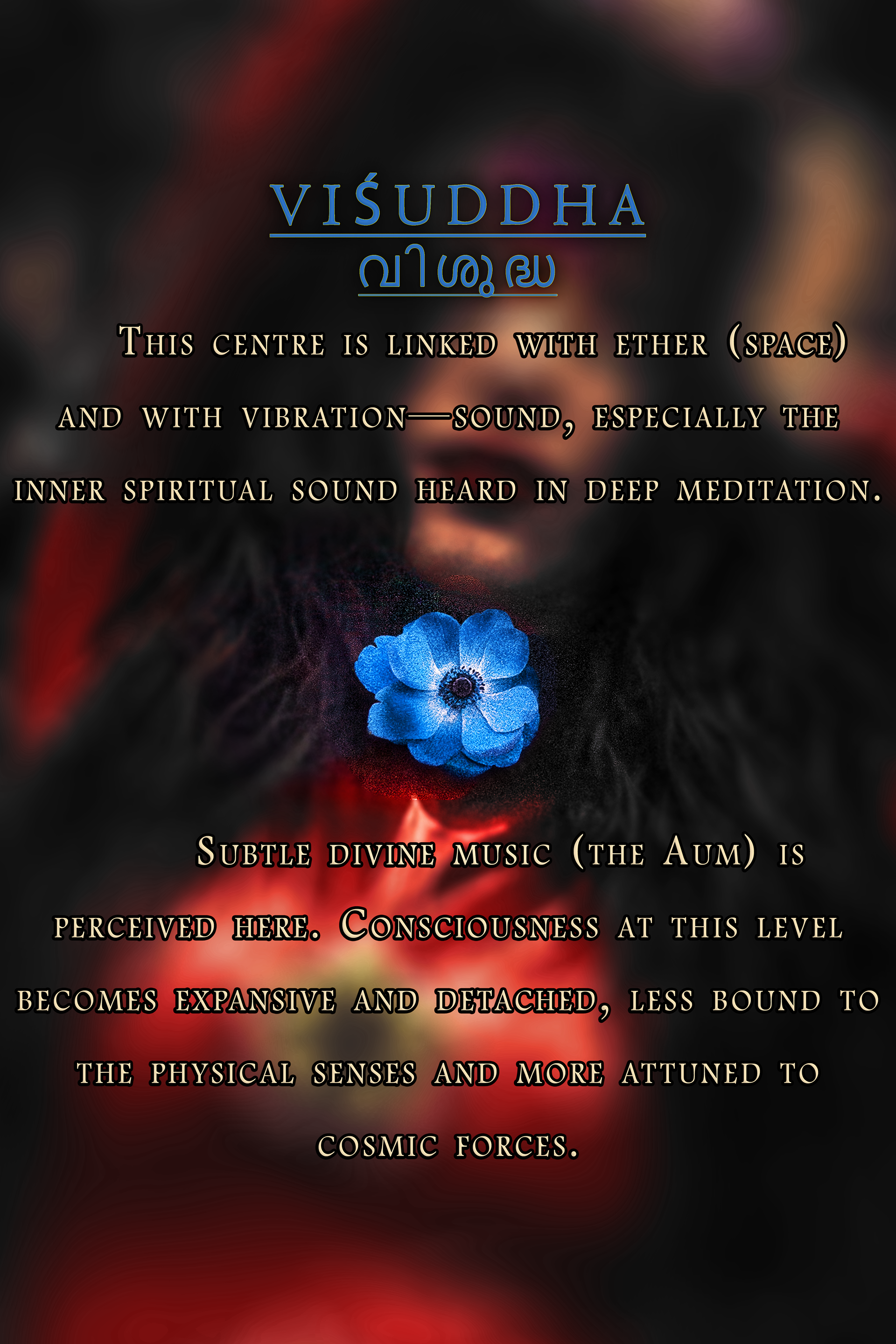
VISHUDDHA CHAKRA — The Cervical Center
Properties and Significance
The Vishuddha chakra governs the ether — the subtlest of the five material elements, the "space" in which all other elements exist. Yogananda teaches that ether is the primordial element from which air, fire, water, and earth successively emerged during creation. At this centre, consciousness approaches the subtlety and vastness of space itself.
The name "Vishuddha" means "especially pure" or "purification." When consciousness ascends to this level, a profound purification of perception occurs. Viveka — spiritual discrimination, the ability to distinguish the Real from the unreal, the Eternal from the transient — reaches its fullest development at this centre. The devotee here begins to perceive the world as it truly is: a play of energy and consciousness, not a collection of solid, separate objects.
The sense of hearing governed by this chakra is significant. Yogananda teaches that sound is the most subtle sensory experience and the closest to the primordial vibration (AUM) from which all creation emerged. At the Vishuddha level, the devotee hears the cosmic AUM as a mighty ocean roar — the sound of all creation reverberating in the ether of consciousness.
This is the level where calmness becomes the dominant quality. Yogananda frequently taught that calmness is the greatest manifestation of spiritual power. At the Vishuddha, the restlessness that characterises the lower centres subsides into a vast inner stillness, like the depth of the ocean beneath surface waves.
State of Consciousness:
Sattva (purity, clarity, harmony) predominates. The mind becomes naturally calm, clear, and discriminative. The devotee perceives the underlying unity of all things, speaks truth with clarity and compassion, and dwells increasingly in an inner atmosphere of spacious tranquillity.
This is the level of the jnana yogi — the one who knows through direct discrimination. Krishna's teachings on knowledge and discrimination resonate from this centre:
"The offering of wisdom (jnana) is superior to any material offering, O scorcher of foes. All actions without exception, O Partha, culminate in wisdom." — Gita 4:33
And: "Even if thou art the most sinful of all sinners, thou shalt cross over all wickedness by the raft of wisdom." — Gita 4:36
At the Vishuddha level, the devotee possesses the raft of discrimination that carries consciousness safely across the ocean of delusion. Connection to the Gita The ether element finds its Gita reference in Krishna's declaration of his divine vibhutis (manifestations): "I am the Atman (Self), O Gudakesha, dwelling in the hearts of all beings; I am the beginning, the middle, and the end of all beings." — Gita 10:20
The all-pervading nature of the Atman mirrors the all-pervading nature of ether. Just as ether contains all other elements within itself without being affected by them, the Atman pervades all experiences without being tainted. Yogananda also connects the Vishuddha to the Gita's teaching on the supreme inner tranquility of the yogi: "When a man is not attached to sense objects or to actions, and when he has renounced all purposes (sankalpa), he is said to have ascended to yoga." — Gita 6:4
The conch Devadatta ("God-given"), blown by Arjuna (representing the soul's faculty of deep concentration and self-control), is associated with this center. At the cervical level, the devotee's concentration is refined to a degree that makes it truly "God-given" — no longer the effortful concentration of the lower centres but a natural, easeful absorption. Yogananda teaches that the Vishuddha is the last of the five "elemental" centres. Above it lies the realm beyond the five elements — beyond the material creation altogether. The ascent from Vishuddha to Ajna represents the crossing of a great threshold: from creation into the uncreated, from the manifested into the unmanifested, from Nature (Prakriti) into Spirit (Purusha).
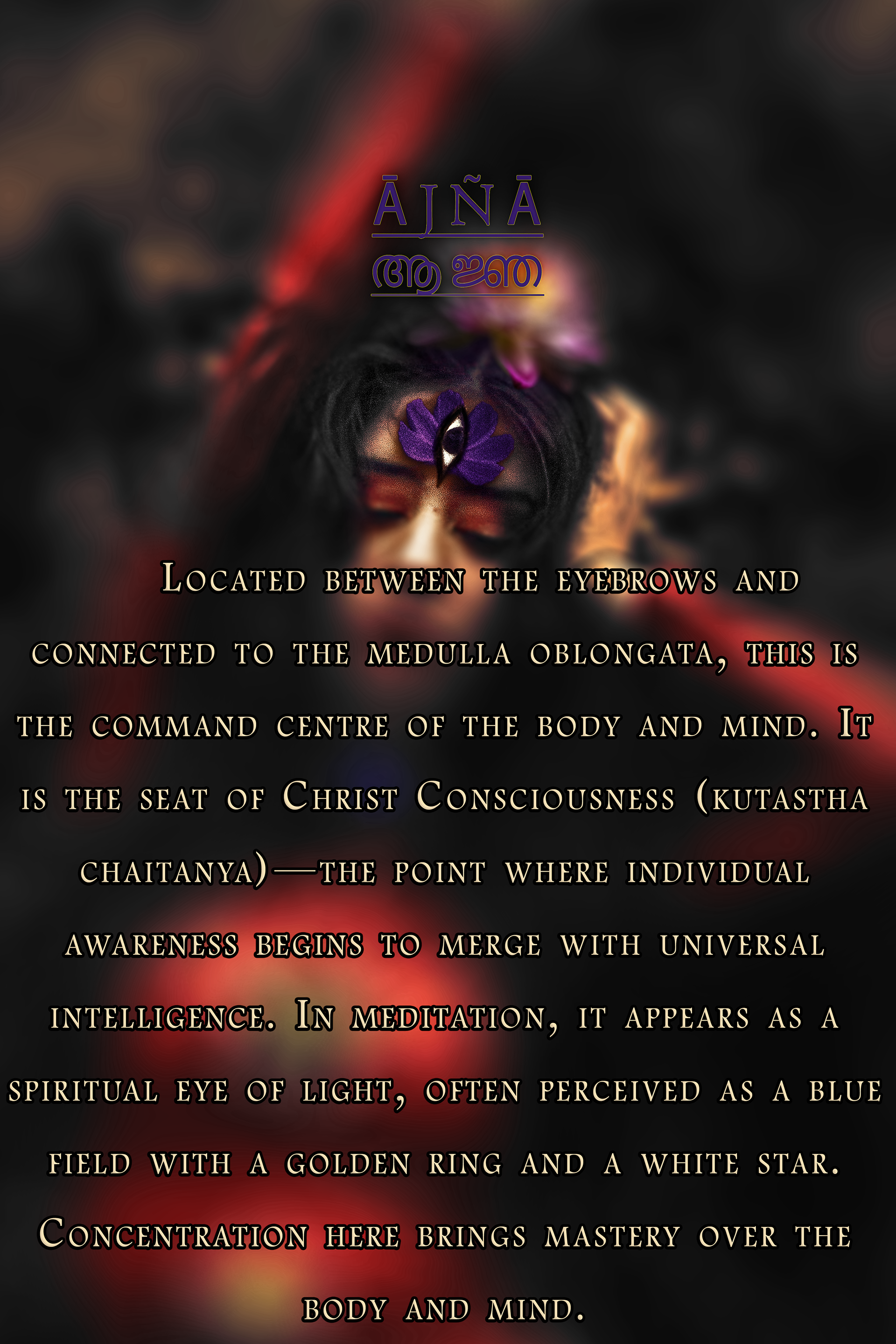
AJNA CHAKRA — The Medullary and Christ Centre
Properties and Significance:
The Ajna chakra is the most important centre in Yogananda's teaching, for it is the gateway to the Infinite. Yogananda calls it the "spiritual eye" — the "single eye" that Jesus referred to when he said, "If thine eye be single, thy whole body shall be full of light" (Matthew 6:22). This is the identical teaching given by Krishna in the Gita.
The medulla oblongata at the base of the skull is, in Yogananda's teaching, the primary entry point of cosmic life force (prana) into the body. It is the "mouth of God" — the channel through which the Infinite keeps the body alive by a constant inflow of cosmic energy. The Kutastha (the point between the eyebrows) is its positive pole — the "broadcasting station" from which the soul projects its consciousness outward into the body and the world.
When the devotee concentrates at this point during meditation, the two poles merge and the spiritual eye becomes visible: the golden ring, the blue field, the white star. These three concentric aspects represent the three aspects of God:
1. The golden ring — AUM, the Cosmic Vibration, the Holy Ghost, the creative power of God (Shakti) — the vibrating energy that creates and sustains all universes
2. The blue-indigo field — Christ Consciousness (Kutastha Chaitanya), the consciousness of God present equally in all creation, the universal intelligence — what the Gita calls Tat (That)
3. The white star — Cosmic Consciousness, Sat (Being), the transcendent Spirit beyond creation — Brahman in its absolute, unconditioned nature.
1. The golden ring — AUM, the Cosmic Vibration, the Holy Ghost, the creative power of God (Shakti) — the vibrating energy that creates and sustains all universes
2. The blue-indigo field — Christ Consciousness (Kutastha Chaitanya), the consciousness of God present equally in all creation, the universal intelligence — what the Gita calls Tat (That)
3. The white star — Cosmic Consciousness, Sat (Being), the transcendent Spirit beyond creation — Brahman in its absolute, unconditioned nature.
Yogananda teaches that the Ajna chakra is the seat of the ego (ahamkara) — but the ego in a dual sense. When directed outward and downward, the ego at this centre identifies with the body and becomes the source of ignorance and bondage. When directed inward and upward — when the gaze is fixed at the spiritual eye — the ego dissolves into its divine source, and the soul recognises itself as the Infinite.
This is the center where Krishna (the Divine Self) and Arjuna (the human soul) stand together on the chariot. It is from this point that Krishna imparts the Gita's teaching. The "chariot" is the body, the "horses" are the senses, the "reins" are the mind — and the "charioteer" (Krishna) guides from the Kutastha center, the seat of supreme intelligence within the body.
State of Consciousness
Beyond the three gunas. At the Ajna level, the devotee transcends sattva, rajas, and tamas altogether and enters the realm of pure, unconditioned awareness. The ordinary fluctuations of the mind cease. Subject and object begin to merge. The "knower" and the "known" start to be perceived as one.
This is the state Krishna describes as the highest yoga: "With the mind not wandering toward any other thing, with the faculty of meditation steadily engaged, and constantly thinking of Me (the Supreme Spirit), one reaches Me, the Divine Purusha (Transcendent Spirit), O Partha." — Gita 8:8
And: "Closing all the gates of the body, confining the mind in the heart, fixing the life force in the crown of the head (through the Ajna center), engaged in firm yoga — uttering AUM, the sacred syllable of Brahman, and remembering Me (Spirit) while departing from the body — he attains the Supreme Goal." — Gita 8:12-13
Yogananda explains this verse as a precise description of the Kriya Yogi's inner practice: the "closing of the gates" is the withdrawal of life force from the senses; the "confining of the mind in the heart" is the centering of devotion; the "fixing of life force in the crown of the head" is the raising of Kundalini through the Ajna to the Sahasrara; and the "uttering of AUM" is the merging of individual consciousness into the cosmic AUM vibration heard at the spiritual eye. Connection to the Gita The Ajna chakra is referenced throughout the Gita, but several verses stand out: "Having known Me as the Enjoyer of all sacrifices and austerities, as the Great Lord of all worlds, as the Friend of all beings — he attains peace." — Gita 5:29
Yogananda teaches that this "knowing" occurs at the Ajna center — not intellectual knowing, but the direct intuitive perception of Spirit that arises when consciousness is concentrated at the spiritual eye. The most direct instruction regarding this center is: "Remaining in solitude, alone, with the mind and body controlled, free from desires and possessiveness, let one practice yoga. Setting for himself a firm seat in a clean place... holding body, head, and neck erect, motionless and firm, gazing at the tip of the nose (nasikagram — the 'origin of the nose,' the point between the eyebrows), not looking in any direction..." — Gita 6:10-13
Yogananda offers a crucial insight into the traditional mistranslation of nasikagram. Most translators render this as "tip of the nose," leading to the image of a yogi cross-eyedly staring downward. Yogananda explains that nasika can mean "nose" but agra means "origin" or "beginning." The origin of the nose is not its tip but its root — the point between the eyebrows. This is the Ajna chakra, the spiritual eye, the seat of supreme concentration. He also connects the famous verse: "What is night for all beings is the time of waking for the disciplined soul; and what is the time of waking for all beings is night for the introspective sage." — Gita 2:69
When ordinary people are "awake" — consciousness flowing outward and downward through the chakras to the senses — the yogi is "asleep" to these distractions, having withdrawn consciousness inward to the spiritual eye. When the yogi is "awake" — consciousness centred at the Ajna, perceiving infinite divine realities — ordinary people are "asleep," utterly unaware of these sublime truths. The reversal of the current of consciousness — from outward-downward to inward-upward — is the revolution that occurs at the Ajna chakra.
Perhaps the most sublime connection is Krishna's declaration in Chapter 11, when he grants Arjuna divine sight: "But thou canst not behold Me with these (mortal) eyes. I give thee the eye divine (divyam chakshu). Behold My supreme yoga!" — Gita 11:8
Yogananda teaches that the "divine eye" (divyam chakshu) is the spiritual eye — the opened Ajna chakra. Through this eye, Arjuna perceives the Vishvarupa — the Cosmic Form of God, containing all universes, all beings, all times. This is the vision that becomes possible when consciousness is fully established at the Ajna center.
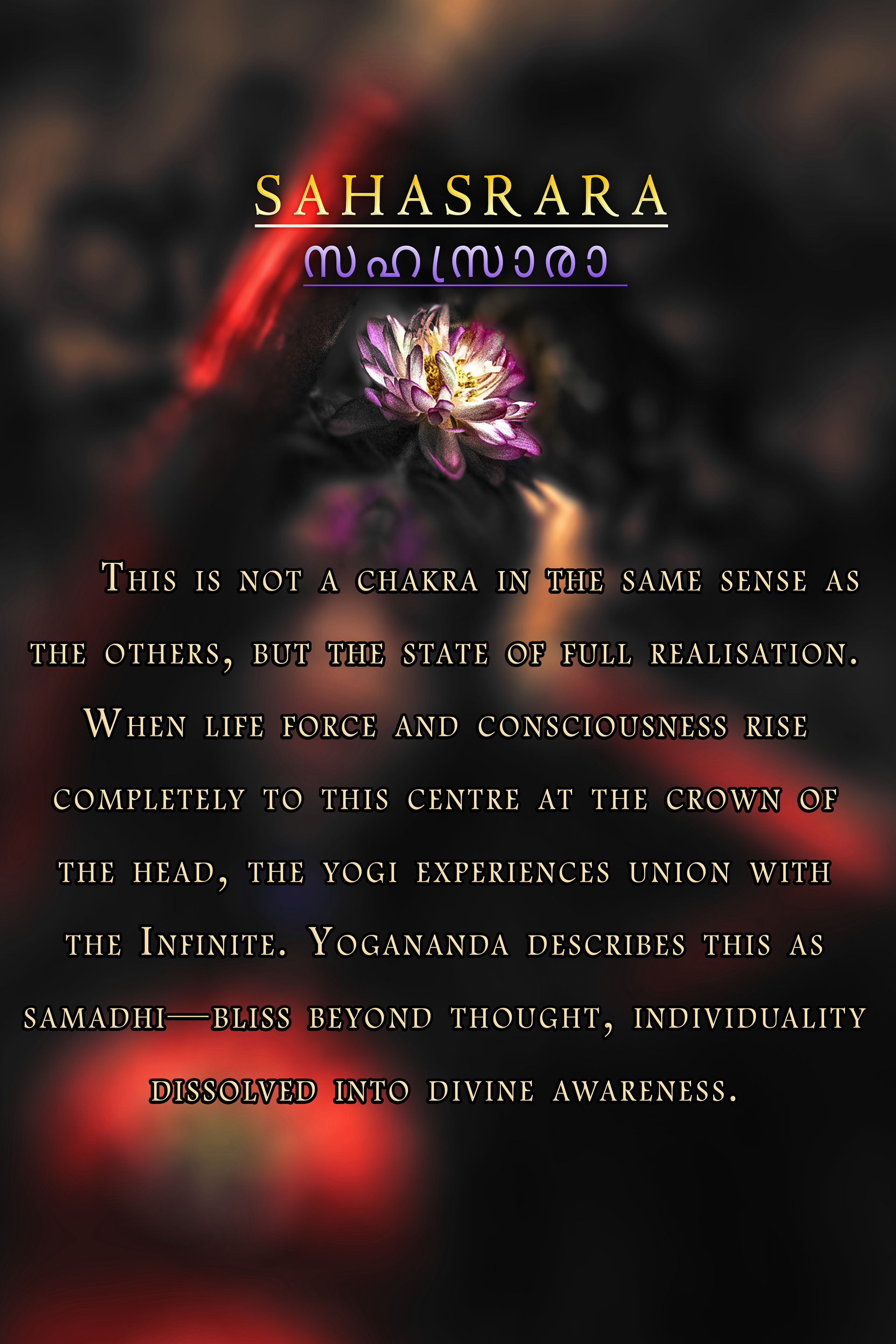
SAHASRARA — The Thousand-Petaled Lotus
Properties and Significance
The Sahasrara is not, strictly speaking, a "chakra" in the same sense as the other six. It is the destination — the ultimate abode of Spirit in the body, the "promised land" toward which the entire pilgrimage of the chakras is directed. Yogananda teaches that the thousand-petaled lotus in the cerebrum is the throne of the Infinite within the human form — the place where individual consciousness merges into Cosmic Consciousness.
When the Kundalini, having been awakened at the Muladhara and raised through each successive chakra, finally pierces the Ajna and enters the Sahasrara, the devotee attains nirvikalpa samadhi — the thought-free, seedless absorption in the Absolute. All sense of duality dissolves. The individual soul realises itself as identical with Brahman — infinite, eternal, ever-existing, ever-conscious, ever-new Bliss.
Yogananda describes this state as the "marriage of the soul with Spirit" — the ultimate goal of all yoga, all religion, all human aspiration. The thousand petals represent the infinite rays of cosmic intelligence emanating from the divine centre — every possible form of divine knowledge and power, every universe and every being, contained within this single point of absolute consciousness.
State of Consciousness
Pure Transcendence. There are no gunas here, no modifications of mind, no subject or object. This is the state described in the Mandukya Upanishad as turiya — the "fourth state" beyond waking, dreaming, and deep sleep. It is awareness aware of itself as infinite.
Connection to the Gita
he Sahasrara is the "Supreme Abode" that Krishna describes throughout the Gita: "That Supreme Abode of Mine is not illumined by the sun, nor by the moon, nor by fire. Having attained it, they return not to this world. That is My Supreme Dwelling." — Gita 15:6.
This verse describes the Sahasrara experience: a light that is not dependent on any external source — self-luminous, self-existing, infinite. The sun, moon, and fire are symbols of the three lower lights (physical light, astral light, and causal light) — all of which are transcended in the thousand-petaled lotus. Yogananda also connects the Sahasrara to: "Having pervaded this entire universe with one fragment of Myself, I remain." — Gita 10:42
And to the ultimate promise: "Abandoning all dharmas (lesser duties), come to Me alone for shelter. I will release thee from all sins (karmic bonds). Do not grieve."
This final verse of Krishna's teaching is the invitation to the Sahasrara — to abandon all partial identifications, all lesser attachments, all limited self-definitions, and to merge completely in the Infinite.